

It is one of the most frustrating things that can happen during a Central Texas summer: your air conditioner is running, the fan is blowing, but the house just will not cool down. Before you assume the worst, there are several possible causes ranging from a quick DIY fix to something that needs a licensed technician. Here is how to work through them systematically.
Start Here: Quick Checks Before Calling for Service
Check Your Air Filter
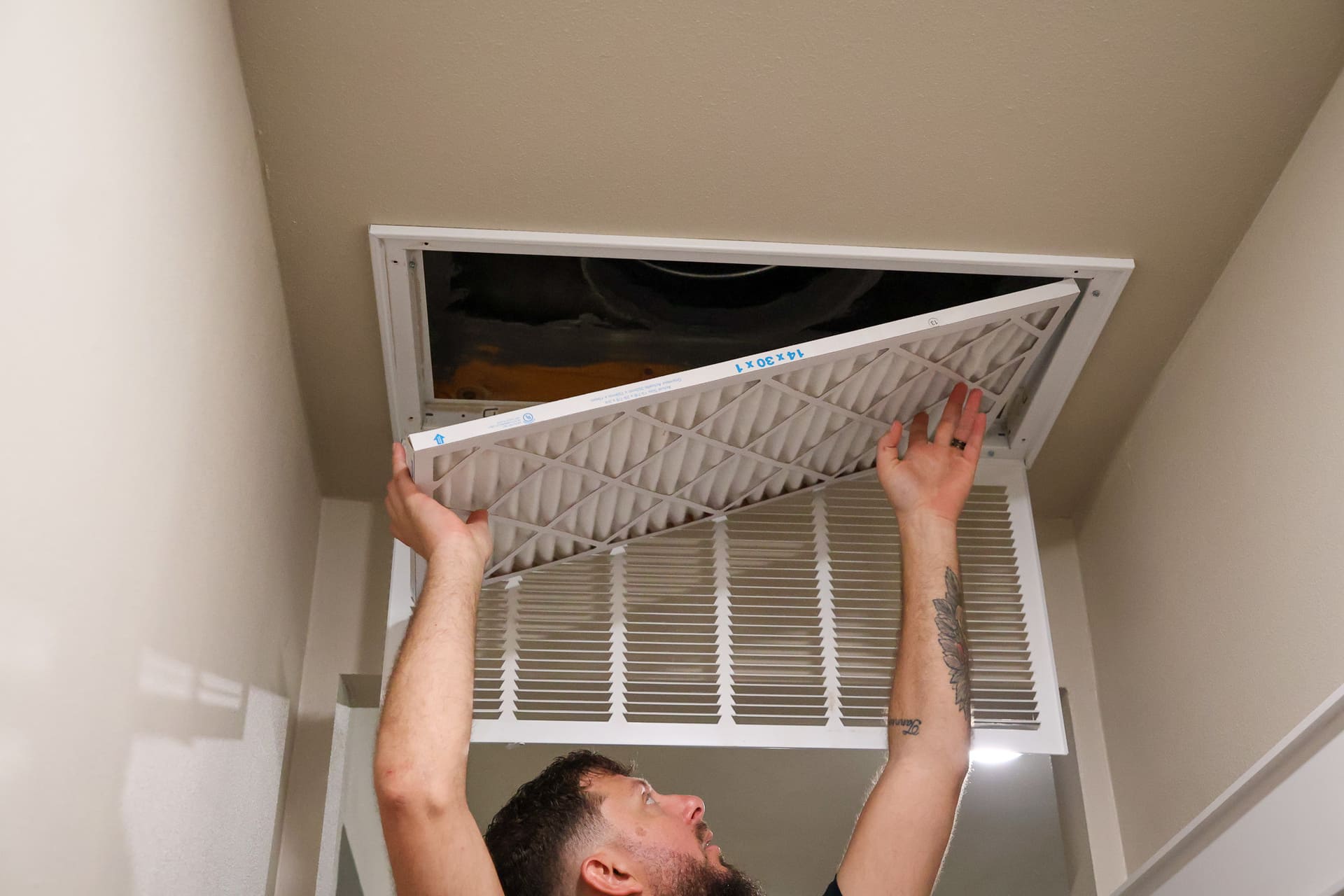
A clogged air filter is one of the most common reasons an AC runs without cooling effectively. When the filter is blocked, airflow across the evaporator coil drops and the system cannot absorb heat properly. Pull the filter out and hold it up to a light source. If you cannot see light through it, replace it. Give the system 20 to 30 minutes to recover and see if cooling improves before moving on.
Check Your Thermostat Settings
Confirm the thermostat is set to cool and not heat or fan only. Make sure the temperature setpoint is below the current room temperature. If the fan is set to “on” rather than “auto,” it will run continuously even when the system is not actively cooling, which can make it feel like the AC is running without doing anything. Switch it to “auto” and see if that resolves it.
How to Reset Your AC
If the system seems to be acting up without an obvious cause, a reset is worth trying before calling for service. Here is the right way to do it:
- Turn the thermostat off.
- Go to your electrical panel and switch the AC breaker off.
- Wait at least 3 to 5 minutes. This is sometimes called the 3 minute rule for AC, and it gives the refrigerant pressure time to equalize so the compressor does not start against unequal pressure.
- Turn the breaker back on.
- Turn the thermostat back to cool and set it below the current room temperature.
- Give the system 10 to 15 minutes to begin cooling before drawing any conclusions.
A reset can clear minor electrical glitches but will not resolve underlying mechanical or refrigerant issues. If the system still is not cooling after a reset, keep reading.
Common Reasons an AC Runs But Does Not Cool
Frozen Evaporator Coil
A frozen coil is one of the most common causes of an AC that blows air but cannot cool. When the evaporator coil ices over, it is encased in frost and cannot absorb heat from the air passing over it. The result is warm or room-temperature air from the vents even though the system is technically running.
Signs your coil may be frozen include ice visible on the refrigerant lines running to the outdoor unit, water dripping near the indoor unit as ice melts, and reduced airflow from vents. If you suspect a frozen coil, turn the system off and switch the fan to “on” at the thermostat to help it thaw faster. Do not run the system in cooling mode until the coil has fully thawed, which can take several hours.
Frozen coils are usually caused by restricted airflow (most often a dirty filter) or low refrigerant. Once the coil thaws, replace the filter and restart the system. If it freezes again, the likely culprit is a refrigerant leak that needs professional attention.
Low Refrigerant
Refrigerant is what allows your AC to move heat from inside your home to the outside. When refrigerant levels drop due to a slow leak, the system loses its ability to cool effectively. You might notice the air from the vents is only slightly cool, the system runs longer than usual without reaching the setpoint, or the evaporator coil freezes over repeatedly.
Low refrigerant cannot be fixed by simply adding more. The leak needs to be located and repaired first, then the system recharged to the correct level. This requires a licensed technician with the proper equipment and EPA certification to handle refrigerants.
Dirty or Blocked Condenser Coil
The outdoor condenser unit is responsible for releasing the heat your AC pulls from inside your home. When the condenser coil is coated in dirt, grass clippings, or debris, it cannot transfer heat efficiently. In Central Texas summers, where temperatures regularly climb into the upper 90s and beyond, even partial condenser blockage can cause significant cooling loss.
Check the area around your outdoor unit. Keep at least two feet of clearance on all sides. If the fins look caked with debris, a professional coil cleaning during an annual AC tune-up is the right solution. Do not attempt to pressure wash the coil yourself, as this can bend the fins and cause further damage.
Failing Capacitor
The capacitor is the component that helps the compressor and fan motors start and run. When a capacitor begins to fail, the compressor may struggle to start, run intermittently, or not engage at all even while the fan continues to blow. This is one of the more common repair items on older systems and one of the more affordable ones to fix when caught early.
Signs of a failing capacitor include the outdoor unit humming but not starting, the system taking a long time to begin cooling after startup, or the compressor cutting out after a short period of running. A technician can test and replace a capacitor quickly during a service call.
Failing or Failed Compressor
The compressor is the core of your cooling system. It pressurizes the refrigerant and drives the entire cooling cycle. When the compressor begins to fail, cooling output drops noticeably. A fully failed compressor means no cooling at all regardless of what else is running.
Signs of a compressor problem include warm air from the vents despite the system running, unusual noises from the outdoor unit such as banging, clanking, or clicking, and the system running continuously without reaching the thermostat setpoint. Compressor issues require professional diagnosis. Depending on the age and condition of the system, repair versus replacement is a conversation worth having with your technician.
Clogged Condensate Drain Line
Your AC removes humidity from the air as it cools, and that moisture drains through a condensate line. When that line clogs, usually with algae or debris, the drain pan fills up and a float switch shuts the system down to prevent overflow. The result is a system that may appear to be running but is not actually cooling because the safety switch has cut off the compressor.
If you notice water pooling near your indoor unit or the system running intermittently without explanation, a clogged condensate line is a likely cause. Pouring a cup of diluted white vinegar down the drain line monthly is a good preventive measure. A full clog usually requires a wet/dry vac or professional cleaning to clear.
Ductwork Leaks or Blockages
If the system appears to be cooling but certain rooms stay warm or airflow from specific vents seems weak, the problem may be in the ductwork rather than the equipment itself. Leaking ducts can lose a significant portion of conditioned air into unconditioned spaces like attics before it ever reaches the living areas. Crushed, disconnected, or poorly insulated ducts produce similar symptoms.
Duct issues are often overlooked because the equipment tests fine during a service call. If your system has been serviced and the equipment checks out but comfort problems persist, duct inspection is the next logical step.
Why Is My House Not Cooling Below 80 Degrees?
During the hottest days of a Central Texas summer, it is worth understanding what you can reasonably expect from your system. Most AC systems are designed to maintain indoor temperatures roughly 20 degrees below the outdoor temperature. When outdoor temperatures reach 100 degrees or above, maintaining 80 degrees indoors may actually represent your system working at or near its capacity.
If the outdoor temperature is 95 degrees and your home is sitting at 80 to 82 degrees, your system may be working correctly. If outdoor temperatures are in the mid-80s and your home still cannot get below 80, something is likely wrong with the system, the ductwork, or the insulation in the home.
Other factors that affect cooling capacity include poor attic insulation, single-pane windows with direct sun exposure, a system that is undersized for the home, and a system that is simply too old to keep up with demand.
How Many Times Should Your AC Turn On Per Hour?
A properly sized and functioning AC system should cycle 2 to 3 times per hour under normal conditions, with each cycle lasting roughly 15 to 20 minutes. A system that runs continuously without shutting off is either undersized, dealing with extreme outdoor heat, or has a mechanical issue reducing its output. A system that cycles on and off every few minutes, called short cycling, usually points to an oversized system, a refrigerant issue, or a failing component.
Both continuous running and short cycling put extra wear on the compressor and shorten the system’s lifespan. If you notice either pattern consistently, it is worth having a technician evaluate the system.
When to Call Lochridge Priest
If you have worked through the basic checks and your AC is still running without cooling, the problem is most likely something that needs professional diagnosis. At Lochridge Priest Home Services, our licensed technicians serve Waco, Temple, Killeen, Belton, Corsicana, and surrounding Central Texas communities with fast, accurate AC repair and honest recommendations.
Call us at (254) 304-8824 or request service online. We are available day and night to keep your home comfortable through the Central Texas summer.